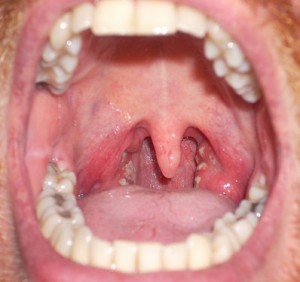
strep_throat_0Strep throat, according to webMD,  is a bacterial infection in the throat and the tonsils. The throat gets irritated and inflamed, causing a sudden, severe sore throat.

What causes strep throat?

Strep throat is caused by streptococcal (strep) bacteria. There are many different types of strep bacteria. Some cause more serious illness than others.

Although some people are quick to think that any painful sore throat is strep, sore throats are usually caused by a viral infection and not strep bacteria. A sore throat caused by a virus can be just as painful as strep throat. But if you have cold symptoms such as coughing, sneezing, or a runny or stuffy nose, you probably do not have strep throat.
What are the symptoms?

The most common symptoms of strep throat are:

* A sudden, severe sore throat.
* Pain when you swallow.
* Fever over 101F.
* Swollen tonsils and lymph nodes.
* White or yellow spots on the back of a bright red throat.

You may also have a headache and belly pain. Less common symptoms are a red skin rash, vomiting, not feeling hungry, and body aches.

Strep throat can be passed from person to person. When a person who has strep throat breathes, coughs, or sneezes, tiny droplets with the strep bacteria go into the air. These droplets can be breathed in by other people. If you come into contact with strep, it will take 2 to 5 days before you start to have symptoms.
How is strep throat diagnosed?

Your doctor will do a physical exam, ask you about your symptoms and past health, and do a rapid strep test to diagnose strep throat. Sometimes another test, called a throat culture, is also needed.

If the rapid strep test says that you don’t have strep (the test is negative) but your symptoms suggest that you do, your doctor may want to do a throat culture to be sure. This is because rapid strep tests are not always accurate. To do a throat culture, the doctor will swab a sample of cells from the back of your throat. The sample will go into a special cup (culture) where the strep bacteria can grow over time. If strep bacteria grow, the doctor knows that you have strep.

If the rapid strep test is positive and says that you do have strep, there’s no need to do the throat culture.
How is it treated?

Strep throat will go away in 3 to 7 days with or without treatment. Doctors usually treat strep throat with antibiotics even though they may not make you well faster. Antibiotics shorten the time you are able to spread the disease to others (are contagious) and lower the risk of spreading the infection to other parts of your body.

There are natural ways to fight the bacterial infection of strep throat!

Gargle with bitter orange essential oil and salt water.

Orange Bitter Essential Oils – 4 oz., (Starwest Botanicals)

Dissolve 1 drop bitter orange essential oil and 1/4 teaspoon salt in 1/2 cup warm water. Gargle twice daily. Do not swallow.

Both, orange bitter essential oil and salt are antibacterial and anti-inflammatory

Echinacea With Goldenseal 100 Caps

Both of these herbs prepare the body to fight a throat infection.

Traditional Medicinals Throat Coat, Organic – 1 box (Pack of 2)

Reduces inflammation that makes it easier for bacteria to infect tissues like those in the throat

Vitamin C W/Rose Hips 1,000 mg 250 Tabs
Plum Flower – 3313 – Clear Wind Heat – Sang Ju Yin Wan – 200 Teapills

Please check with your doctor before taking any supplements, and also read the warning labels on each product, especially if you are pregnant or breast-feeding. Also read the labels carefully when giving your child any natural supplement, to ensure that it is safe to give a child.

Take all of these and fight streap throat naturally!

Popularity: unranked [?]

Check Out These Related Posts:

    None Found

For some people antibiotics are the cure all medicine and one of the best gifts from god, for others they feel they are responsible for everything that is wrong with western medicine and yet the majority of people are somewhere in between these two extremes. We decided to separate fact from fiction and give you some alternatives to antibiotics if you are concerned about their over use! We will do a 6 part series. The first part will provide some facts as they are presented by the Mayo Clinic website. Part 2 will provide alternatives in the event you have strep throat. Part 3 will cover alternatives to antibiotics if you have a sinus infection. Part 4 will give you some natural remedies for urinary tract infections. Part 5 will provide antibiotic alternatives for an ear infection and finally part 6 will cover bronchitis!

antibioticAntibiotics – Good and Bad

Your head throbs, your nose is stuffy, and you’re too tired to do anything but flop into bed at the end of the day. You’re probably coming down with a cold or the flu. But if you think that antibiotics will help you feel better, think again. Antibiotics won’t do a thing for viral illnesses such as colds, flu and most sore throats. What’s more, taking antibiotics when you don’t need them actually can be harmful. Here’s more information on what antibiotics are, when they should and shouldn’t be used, and what you can do to combat antibiotic resistance.

What are antibiotics?

Antibiotics are powerful drugs used for treating many serious and life-threatening infectious diseases, but taking them when you don’t need to can lead to antibiotic-resistant germs. Antibiotics are only effective against bacterial infections, certain fungal infections and some kinds of parasites. Most infections result from either bacteria or viruses. Antibiotics can’t help you if a virus is responsible for your illness.

Bacterial infections cause:

* Some ear infections
* Severe sinus infections
* Strep throat
* Urinary tract infections
* Many wound and skin infections

Viral infections cause:

* Most ear infections
* Colds
* Influenza (flu)
* Most coughs
* Most sore throats
* Bronchitis
* Stomach flu (viral gastroenteritis)

How antibiotic resistance develops

Since penicillin was introduced in the 1940s, scientists have developed more than 150 antibiotics to help stop the spread of infectious disease. But although these drugs have saved millions of lives, the misuse of antibiotics has caused problems. Their frequent use, often for conditions or infections that aren’t caused by bacteria, has given rise to bacteria that are resistant to many commonly used antibiotics.

Superbugs emerge when an antibiotic fails to kill all of the bacteria it targets, and the surviving bacteria become resistant to that particular drug and frequently other antibiotics as well. Doctors then prescribe a stronger antibiotic, but the bacteria quickly learn to withstand the more potent drug as well, perpetuating a cycle in which increasingly powerful drugs are required to treat infections.

Antibiotic-resistant strains of bacteria began to appear soon after penicillin was introduced. Today, antibiotic-resistant strains have become common, and bacteria resistant to a number of antibiotics have developed. Once only seen in hospitals, outbreaks of some resistant strains — such as methicillin-resistant Staphylococcus aureus (MRSA) — are appearing in the wider community.

For years, the potent antibiotic vancomycin (Vancocin) was a reliable last defense against certain severe infections, notably those caused by staphylococcus bacteria. But in recent years, some superbugs have become able to resist vancomycin.

While experts are working to develop new antibiotics and other treatments to keep pace with antibiotic-resistant strains of bacteria, infectious organisms adapt quickly. Antibiotic-resistant bacteria will continue to be a global health concern — and using antibiotics wisely is an important part of preventing their spread.

Consequences of antibiotic resistance

When more and more bacteria become resistant to first line treatments, the consequences are severe. Illnesses last longer, and the risk of complications and death increases. In the United States alone, thousands of people die each year of infections they contract in the hospital from antibiotic-resistant bacteria. The inability to treat a particular infection leads to longer periods in which a person is contagious and able to spread the resistant strains to others.

The failure of first line treatments also means that doctors have to resort to less-conventional medications, many of which are much more costly and more toxic than common drugs are. For instance, the drugs needed to treat multidrug-resistant forms of tuberculosis (TB) are much more expensive than are the drugs used to treat nonresistant TB. The course of treatment is long — up to two years — and the side effects can be severe.

Other consequences are the increased costs associated with prolonged illnesses, including the direct expense for additional laboratory tests, treatments and hospitalization, and the indirect costs from loss of income or time away from family.
Safeguard effective antibiotics: What you can do

Using antibiotics too often or incorrectly is a major cause of the increase in resistant bacteria. Here are some things you can do to promote proper use of antibiotics:

* Understand when antibiotics should be used. Don’t expect to take antibiotics every time you’re sick. Antibiotics are effective in treating most bacterial infections, but they’re not useful against viral infections, such as colds, acute bronchitis, or the flu. And even some common bacterial ailments, such as mild ear infections, don’t benefit much from antibiotics.
* Don’t pressure your doctor for antibiotics if you have a viral illness. Instead, talk with your doctor about ways to relieve the symptoms of your viral illness — a saline nasal spray to clear a stuffy nose, for instance, or a mixture of warm water, lemon and honey to temporarily soothe a sore throat.
* Take antibiotics exactly as prescribed. Follow your doctor’s instructions when taking prescribed medication, including how many times a day and for how long. Never stop treatment a few days early if you start feeling better — a complete course of antibiotics is needed to kill all of the harmful bacteria. A shortened course of antibiotics, on the other hand, often wipes out only the most vulnerable bacteria, while allowing relatively resistant bacteria to survive.
* Never take antibiotics without a prescription. If you didn’t complete a full course of antibiotics, you might be tempted to use the leftover medication the next time you get sick or to pass it along to someone else. But this isn’t a good idea. For one thing, the antibiotic might not be appropriate for a future illness. And even if it is, you’re not likely to have enough pills to combat the germs making you sick, which can lead to more resistant bacteria.
* Protect yourself from infection in the first place. Good hygiene can go a long way in preventing infection. Wash your hands thoroughly with soap and water, especially after using the toilet, changing a diaper or handling raw meat or poultry. Keep food preparation areas clean. Although antibacterial cleaners and soap are widely available, they aren’t necessary. Plain soap and water works fine to kill germs in most settings.

What about antibiotic in our food?

The volume of antibiotics used to treat human illness pales in comparison to the volume used in industrial farm animal production. In 2005, the Union of Concerned Scientists noted that while 3 million pounds of antibiotics were being used in human medicine each year, the food animal industry was using 24.6 million pounds, primarily to stimulate growth and increase production. These are some staggering numbers that should really concern all of us.  So, if you are concerned,  100% organic foods will be a good alternative. Please visit a very interesting website at www.ThatsSuperFood.com and read the article “So What Does “ORGANIC” Really Mean?”. Very interesting information!

Popularity: unranked [?]

Check Out These Related Posts:

    None Found
Improve the web with Nofollow Reciprocity.